The whole truth about October 17, 1806, the physical assassination of His Majesty Jean-Jacques Dessalines


Google translation, from French to English
The whole truth about October 17, 1806,
the physical assassination of His Majesty Jean-Jacques Dessalines
Read the text and act, quickly! You must read it to the end, however long it takes. It concerns you, your life, your future, etc. The action you take after, and even before, reading this text, which has been meticulously prepared for you, will reveal you to yourself. I wish you success.
Share widely, first, and then communicate with everyone to act quickly! Time is running out!
For things to go well and continue to go well, Christianity, particularly the Roman Catholic Church, is persona non grata throughout the Imperial Territory, that is to say, here as elsewhere, and its teachings are forever silenced.
As for the French Republic, France, it is no longer among the nations. It is irrevocably destroyed. Its original members, of course, are now left to their own devices and can return to their own internal structures to reorganize themselves or become what they were before their disgrace, their fall, if that is their desire. It depends only on them. The only thing beyond their control is their reconstitution under the same foul and toxic model. There is no longer any place for infamy on this land, our land, the land of which we are the indigenous people, for we intend to fulfill, unwaveringly and irrevocably, our Dessalinian Role, in the interest of each and every one of us.
The Dessalinian trilogy is lethal; it is the dagger to the heart of the greatest evil of all, human evil. No one who dies can return, nor does anyone return to life. The dead are forever dead, and so slavery, the enslavement of humanity, from whatever angle one views it, is forever abolished. This is final. These are words, independent of any will, written in indelible ink upon all memory. The natural enemy, to borrow the vocabulary of the Invincible General and His Majesty the Eternal Emperor Jean-Jacques Dessalines, is persona non grata on the Imperial Territory, which includes all the original territories of our Ancestors, the ancestral continent, as well as those where all our kidnapped and deported Ancestors are located. The declaration of the abolition of “slavery” does not recognize any coexistence with the original authority of the slave owner. It forbids it outright. The correction must be made without delay; logically, there can be no coexistence between two antipodal and antithetical entities, and history has no further continuation. Things have returned to their normal course, and it will remain so irreversibly.
Décret 0000000 20 juillet 2026 Toute la vérité sur le 17 octobre 1806 0000000
The Imperial Family and the City of Dessalines speak out 7 - 8 - w = © All rights reserved
q = an, u = ou =, w = r, r = ê, c = in, h = ch, e = é, ¼ = on, ñ
The original link if needed:
https://www.linkedin.com/pulse/toute-la-v%25C3%25A9rit%25C3%25A9-sur-le-17-octobre-1806-assassinat-de-ohode
Visit the following sites:
LinkedIn: HRH Prínce Tiécoura Jean Dessalines D'Orléans;
Blogger: Forum-Impératrice Claire Heureuse Dessalines, la Ville de Dessalines, capitale d’AYITI;
X: @ForumEmpereurje
For all works, consult the Akadémie X website:
https://www.akademiex.com/product-page/tome-6-l-administration-impériale-rétablie-au-pays-ancestral-ayiti
Administration impérial rétabli
Slavery is the crime against Busa, or against the Black man and woman, Earthling, Earthling.
AYIBOBO!
The Dessalinian Trilogy: A Stab in the Face of Human Evil
We are faced with three great phenomena that no one can overcome. If it were possible, the slave trade would run rampant across the planet. True cannibalism would undoubtedly drain it of its substance. Fortunately, the vital trilogy is unbeatable. It stems from the will to be in oneself, by oneself, and for oneself, a will that is the fruit of Ancestry, knowledge and production reflecting Things in themselves, until proven otherwise.
Let's delve a little deeper! The first of these phenomena is the military genius of Jean-Jacques Dessalines; he is invincible. The second is his exceptional skill as a scholar; he naturally masters his subject through ancestral knowledge. The third is his Title of Emperor, distinguished by his Existential Eternity, which stems from the necessity for the Munal Being to assume a perceptible form in the world, as his Highest Point of Being, which is His Perfection, his immediate purpose, in order to participate in the Divine Movement, a Continuous Force, capable of Manifesting the Presence of Being, the All, which is the Second Purpose. This is the Divinity active within itself, following its own frameworks, inscribed in its Mbwa, to immobilize human Evil, the chimerical thought that grinds the elements of planet Earth in order to give itself an effective future.
The Dessalinian trilogy finds its first necessity in the Great Purpose, the Second, that is to say, the Continuous Movement for Continuous Production with a view to the Manifestation of the Presence of Our God, Good God, GwqmrtLa. The second stems from a part of municipal reality, the experience and the means of overcoming it. Let us recall the following words spoken to highlight the objective or cause of the Eternal Empire of AYITI: “Considering that after a long series of misfortunes and vicissitudes, it is necessary to ensure the guarantee and security of citizens in an immutable and irrevocable manner.” The Letter of Appointment, Port-au-Prince, January 25, 1804. This is the enunciation of the Empire of AYITI as a necessary, indispensable, and immutable—that is to say, eternal—means of attaining Perfection, which is also called Negro-divinity, in the sense of a life lived in complete harmony with oneself. It is like saying that Dessalinianism is inscribed in the course of Things and that human Evil, particularly whiteness, actualizes it. Our God, Good Lord, in foreseeing humankind, gave him the answer at the same moment.
There is a twofold necessity for the same object. The second stems from ancestral experience, while the first is meta-experience, that is, the Reason for our presence. Thus, Dessalin's trilogy doubly involves communal reality: in its first part, the Original, or a priori, and in its second, experience, encompassing all attempts to approach the Original in order to destabilize it. The a priori and experience unite, converge, in the will to maintain oneself in Life, a will that derives from Ancestry, the Dqmbala of reality, what we are and its Source, Our God, Good Lord. The circle is complete. With no way out, the slave owner is trapped.
Self-Conception and Life Project
It is important to remember this. Self-conception, that is, what we are to ourselves, is the driving force behind action. The action attached to it is what we call a life project. We cannot say that a certain behavior is what suits us without knowing what we are. That would be foolish. “What suits us” refers to what we are or what we say we are in essence. Every collective organization aims at the realization of this essence, what we are, our self-conception, etc. To achieve this objective, we must adopt appropriate behaviors. There are two examples to consider: 1) An anthropology of natural law, by which we must understand a self-conception, calls for a collective organization of the every-man-for-himself type; appropriate behavior implies the essence, namely every-man-for-himself; this does not go without the will to rise above others, hence a conception of hierarchy; 2) An Ubuntu-type conception of self means that one cannot exist without the other; all elements form a unity; no element can be above another: in everything, they work together for the good of the whole; hierarchy is counterproductive; the whole leads itself and rejects any thought of submission, which is domination. Such is Ancestry, that is to say, US, what we call the Muc, a unity, being in itself, by itself, and for itself.
The society of natural law is not a new way of defining oneself in the world. It is the continuity of the hierarchical conception of self. It is new in its mode of realizing the binary self. It is inherent to its essence. It could not be otherwise; one is irrevocably attached to what one is or what one says oneself to be. It is the way of seeing the world, of seeing oneself in the world. This populates humanity with unidirectional beings. This is why the natural enemy, who works toward its “realization” by resorting to outright cannibalism, refuses to submit to the Dessalinian trilogy. The only way to express opposition is to attack the Eternal Empire of Haiti. Since His Majesty Jean-Jacques Dessalines is its foundation and Founder, he is the targeted Element. He tried countless times without success until October 17, 1806.
The Re-establishment of the Framework of Slavery
We will take a shortcut in discussing this. Let us simply say that the hierarchical structure within the communal lakort, aimed at achieving domination by a small group—what the slave owners themselves call “slavery,” the precise term being enslavement—has always been a reality. It has taken different forms and is carried out by various groups of people, depending on the era. Let's turn to our recent ancestors! In 1493, Pope Alexander VI, born Roderic Llançol i de Borja (1431-1503), divided the world and gave its share to each group of people under his authority. Our continent (Jelefwe or Gelefwe) went to the Portuguese.
Tommaso Parentucceli (1398-1455) became pope and took the name Nicholas V. On January 8, 1454, Pope Nicholas V ordered Afonso V, sovereign of Portugal, to enslave the Black men and women of the ancestral continent. The establishment of slavery meant officially instituting the domination of men—a term by which Europeans defined themselves—over Black men and women, the subhumans. The papal bull of Nicholas V is based on the biblical myth that Negresses and Negroes are descendants of Ham, a race cursed by the god of the Bible, the god of whites, to use the name that Jean-Jacques Dessalines Plus Que Grand gave him.
This historical fact reveals two things of Dessalinian importance. The first is the ideological nature of “the slave,” and consequently, “slavery.” “Slaves” are specific groups of people. Working for someone other than oneself does not make one a “slave.” The cause lies elsewhere, in “who one is.” However, one works for someone other than oneself because one is a “slave.” “Slavery” is a consequence; in other words, “the slave” precedes “slavery.” The Bible provides proof. The Enlightenment thinkers in France established the naturalness of “the slave.” Before them, there was Aristotle. The specificity of their ideology of “the slave” is the marriage of philosophy, in this case, the thought of Aristotle, and theology. Hence, whiteness! This is discussed in several Decrees here. This enduring nature of “the slave” is expounded in the discourse of politics, the arena where this practice is carried out. Let us listen to the words addressed to our Ancestors of Karukera, called Guadeloupe, after having imposed respect for their Guadeloupean identity on France on October 21, 1801: Vice-Admiral Denis, Duke of Décrès (1761-1820), Minister of the Navy in 1801, declared on November 14, 1801: “I want slaves in the colonies. Liberty is a food for which the stomachs of Black people are not prepared. I believe that we must seize every opportunity to give them back their natural food, except for the seasonings that justice and humanity dictate. I believe that we must send a considerable force to Guadeloupe, not to reduce it to what it was, but to what it should be.” These words are perfectly in line with the ideology of “the slave.” They proclaim loudly and clearly that the slave owner is its pure product. And this is not without reason.
The other point to emphasize is the agent of “slavery,” the institution responsible for translating ideological discourse into reality. If “the slave” is a product of the white man’s god, to use Jean-Jacques Dessalines’s terminology, then the entity that represents him in the tangible world bears the responsibility. This entity, as we saw earlier, is the Church or Christianity. Everywhere, the Church is behind the “conquest of slaves” and the government, even among the English, but their church. The God of the Bible transforms specific people into “slaves.” The Apostle Paul condemns any insubordination of “slaves.” This is disobedience to God, since insubordination is the transgression of the order established by God, the God of the Bible. The Church asked France, the eldest daughter of the Church, to establish its slave-trading activities in the Caribbean. Secular France, it says it all, while it criticizes “the regime of the mollas”—to use its own terminology, there is only one molla, it should be emphasized—this betrays the intention of enslavement, denigrating in order to destroy and appropriate because it is not Christian—is staffed with the Church's arms in all important branches of power, particularly the armed forces. In Saint-Domingue, the Church reigns. “Politics,” argues the Greek philosopher Aristotle, “is the means of bringing about slavery.” The Bible, in the same vein, affirms that “all power comes from God.” This idea highlights the fact that the god of man harbors the desire to seize life on earth. Behind this lies the notion that the Church is the holder of divine power. It is the Church that transmits it to the political leader. Thus, “slavery,” linked to politics, is an activity of the white man's god. When we hear about secularism, we're talking about the separation of the clergy, not the church, from politics—that is, the church as head of state. It's a coup d'état, which isn't surprising because it's a system of true cannibalism. In the English system, things are different. The head of the church is also the head of state. In the United States of America, the country of origin of the English, religion is at the heart of the system without being in control. It's present at every seizure of power or assumption of office, when going to war—in short, everything related to the system, their system, and to maintaining the system. The Vatican has this noble custom of blessing the arms of the country it claims as its own so that they may be prolific in deaths and lead to victory, the victory of conquest. All in all, throughout the entire period of slavery, the Vatican is in direct contact with the religious leaders.
The key takeaway from all this is that sovereignty is composed of two elements: spirituality and politics. It is the means of objectifying the "slave" for the sake of "slavery," or enslavement, which signifies domination. This is not limited to relations between people of different skin tones, but extends to citizenship and the State, to power itself. For example, in France, to legitimize the republic, the revolution adopted the concept of "sovereignty" from the royal system, which, according to the founding French ideology, is divine. This allows the Church to remain active, but without the power to command. It is therefore illogical (nonsensical) to abolish "slavery" (enslavement) within this worldview. On a global level, the concept of self, from a human perspective, particularly a white one, is inseparable from domination, and thus from enslavement.
Politics and Slavery
The first thing to firmly grasp is that politics aims to shape people. It's not about shaping for the sake of shaping; that would be meaningless, without purpose, and therefore senseless. No, no, it's not that at all. This shape is the thought of the "slave," something specific, which leads only to "slavery" (enslavement), a way of situating oneself in the world in relation to others, certain others specifically, those who have the upper hand (the master), through cunning or force. It does this by replacing what makes people who they are, namely their beliefs in themselves, whatever they may be, with something else. People draw sustenance from sovereignty. This sovereignty, through the thoughts that compose it, is the source of everyone's being. It is the principle of citizenship. Citizenship is the sum total of dictated conduct. This act is called creation, a construction through deconstruction. I recommend reading my book to get a clear understanding:
THE RAZOR PRINCE III
His Majesty Prince Weber Tiécoura Dessalines D’Orléans Charles Jean Baptiste
THE SKELETON MAN OF THE ARTIFICIAL ORDER OF LAW
OR
VOLUNTARY ENSLAVEMENT BY TRAP
Collection:
In the Name of Princess Atala Dessalines D’Orléans
Fleur des Champs
Volume VIII
LOF Editions
LEKBA/OGU/FWEDA
Legal Deposit 1st Quarter 2020
or 280th Year of the GWQMUNALITY, of the
BEAUTIFUL BLACK WOMAN
National Library of Quebec
ISBN 978-2-923307-09-1 All rights reserved
No reproduction, in whole or in part, of this book, this undeniable gem, is permitted. is not allowed
Some recommendations from the same author
No, I don't want to die Or The big question posed to the province of Quebec
My great sorrows I can't take it anymore
To the glory of Carapha, my father
France is her name
Letter to Lekba (on Canadian and Quebec despotism) Or sispqn wqse
I speak out Human rights are anti-Black
Down with love Long live municipal recognition or To an extraordinary girl, an extraordinary boy and vice versa
Whiteness before the tribunal of the Negro-divinity
The bicolor, end of humanity, genesis of the Negro-divinity
In the name of Atala D'Orléans Fleur Deschamps
Quebec and Canada before the tribunal of the Negro-divinity
Dessalines-ville Imperial Capital of planet Earth (1503-1803) and (1803-2003) The Emperor is dead. Long live the Emperor!
Let the Dessalines of our being emerge.
For a Quebec in his image, or from society to the Quebec Republic (enhanced text)
Sketch of the biography of one of the emblematic figures of the city of Rivière-Rouge, Laurent Larose
The real Laurent Mercure
The face of Dessalines-Ville, Imperial Capital, Two Hundred and Six Years Later, October 17, 1806 - October 17, 2012 And For a new planet Earth
The Razor Prince, or the Re-established Imperial Administration, Montreal 2019
Human Rights Are Anti-Black II, or The Razor Prince II, Montreal 2019
In preparation: Together Against Slavery
The monstrosities of the French language (the constitutive monstrosities of French)
Man, this cruise, Have fun!
Do you know Philippe Charmant Célestin, the Giant? Then follow me!
To understand gelefwo-masuana (cultural grammar)
tttttttttttt
To return to politics, under the control of this order, people lose control of their destiny. Someone other than themselves leads. By dictating their conduct, this order makes them what is inscribed in its thinking, that is to say, “slaves,” or at best, the equivalent. They are mastered, therefore dominated. Is this idea of ??“slaves,” attributed to people, true? Obviously not! Their state of being is not a reality ofowu, that is, as it emerged from the Divinity of Our God, Good Lord. It is impossible to alter the ofowu state of being, but it can be submerged under a pile of clutter. What they become is a pragmatic truth. However, where politics encounters unbreakable resistance, even simple resistance, is in the recourse, here and now, to horror, even the pinnacle of cruelty in some cases, to thwart it. This recourse establishes a difference between morality and politics. Political violence knows no bounds.
Our Ancestors, through Jean-Jacques Dessalines,
facing the true cannibals
Everything I've just said brings something important to the fore: the idea of ??gods and religion is everywhere and in everything. This idea is the carpet of the planet, and slavery is its crown, both internal (national) and inter-relational or international. I don't know how the minority who don't believe in it manages. They face a constant contradiction. That's life on Earth. Jean-Jacques Dessalines, a child of Ancestry, is not intimidated. On this carpet, he proclaims, loud and clear, "Our God." These words are an affirmation of Self, of Ancestry. His judgment is final, for he continues, "Good Lord." A well-placed kick, in the right spot, we all know where. Bukmqn, on the night of August 14, 1791, reported the reason for Dessalines' rejection: "Our God, Good God, God Producer of all things, especially the earth, the sun that illuminates us, the oceans, the thunder! God, Our God, Good God, etc." The gods being spoken of have produced nothing; they are laughable gods. Jean-Jacques Dessalines calls them "the gods of the whites," that is to say, of whiteness. "We," he says, "are not slaves but prisoners condemned to work in the fields." Jean-Jacques Dessalines returns with the Affirmation of the Muc. The fact that he says it proves, without a shadow of a doubt, that our Ancestors are not subjugated and that they remain entrenched in their Muc. The struggle of our Ancestors is the struggle against the ideology of "the slave," the carpet of planet Earth. Everything they undertake aims at the total destruction of this ideology. In response to his appointment as Emperor, Jean Jacques Dessalines, regarding the Eternal Empire of Haiti, said: “If any considerations justify in my eyes the august title that your confidence bestows upon me, it is undoubtedly my zeal to watch over the safety of the Empire, it is my will to consolidate our enterprise, an enterprise which will give the nations least friendly to liberty not the opinion of us as a mass of slaves, but that of men who value their independence above all else, to the detriment of that consideration which the powers never grant to peoples who, like you, are partisans of their own liberty…”. The Empire of Haiti, which Jean-Jacques Dessalines, the ever-victorious General, was destined to found, the final phase of the struggle, aimed at the definitive eradication of the concept of "slavery," the source of politics and the means by which "slavery" was institutionalized. Thus, our ancestors, again through Jean-Jacques Dessalines, son of Elisabeth and raised by Agbawaya Toya, revealed themselves as the fierce and invincible adversaries of the slave owners.
The battle is being fought on two fronts: the military and the leadership. The military aims at the physical cleansing of the land; leadership is the art of self-governance. We have won the military victory forever because we have driven the slave trader, with determination and fervor, from our existential sphere. We are working on the final phase: the Foundation of the Eternal Empire of Haiti. This Grand Work is our way of being in the world. “We dared to be free, let us dare to be free by ourselves and for ourselves,” said Jean-Jacques Dessalines. To ensure he was understood, Dessalines added: “Let us follow in other footsteps!” In other words, we must have our own path because that is what it means to be Gwqmun. Let us pretend that others do not exist. “Let us swear to the entire universe, to posterity, to ourselves, to renounce France forever, and to die rather than live under its domination. To fight to our last breath for the independence of our country! The Empire of AYITI is irrefutable proof that we are not “slaves.” What we are is inseparable from the Empire of AYITI. It is our Being in the sensible world. To put it another way,
what we are is the Empire of AYITI. Here we lead ourselves. We cannot renounce this: “If I have been fortunate enough,” said Jean-Jacques Dessalines, “to place in your hands the sacred trust you have placed in me, remember that it is now up to you to preserve it.” Resignation is inappropriate. There are no “slaves,” there never have been. The Gwqmunité, the act of leading oneself, is a Mbwa of the Being that we are, that is, the MUN. Jean Jacques Dessalines' condemnation of the traces of true cannibalism is quite logical: "Everything there retraces," he said, "the memory of the cruelties of this barbaric people; Our laws, our customs, our cities, everything still bears the French imprint (...) and you think you are free and independent...” These words of Jean-Jacques Dessalines should be seen as a call for a cleansing, to root out everything that is not us, primarily France. Dessalines certainly doesn't limit himself to France, but also to white supremacy and even further to slave owners, since it is a matter of acting within oneself, by oneself, and for oneself, a campaign in favor of Self-Affirmation, the Lakortal Self. In our sphere, says Jean-Jacques Dessalines, there is only US. It is not fear of others that drives Jean-Jacques Dessalines to resort to this cleansing. When one is ubuntu, one reaches out to others who are not truly like us. They are still US. Ubuntu is Unity. However, the people we reject are fundamentally foreign to us. They do not fit into our framework: “...they are not our brothers, they never will be.” They are everything that is not right for us, an obstacle to who we are: “If they find refuge among us, they will still be the instigators of our troubles and divisions.” It is not our communal essence that is in question, but the human substance versus the communal quintessence. This makes them true cannibals; they invade you and seek to absorb you, then kill you if they fail. That is all they are. Jean-Jacques Dessalines' response to General Quentin, commander of the city of Saint-Marc, reveals this unequivocally: "I raised the banner of the Resistance because it is time to teach the French that they are monsters whom this land devours too slowly for the happiness (the appropriate word is blrz) of the community." Perception through actions is all that matters in this context: "What do we have in common with this executioner people?" His cruelty compared to our patient moderation.” Each group acts under the influence of its self-perception. Man reveals himself to be cruel because he is a slave owner and is judged as such. This is the basis of our confrontation, total separation; such was the objective of our Ancestors in the shadow of the Invincible General and Eternal Emperor Jean-Jacques Dessalines. Man’s reaction: whiteness.
Faced with the independence of the Ancestors, the slave owner finds himself trapped. He cannot accept the fact that a significant group of people is beyond his reach. There is more. These people, through the Erection of the Eternal Empire of AYITI, establish themselves as the Point of Salvation of the earth. We saw in the previous Decree, “They are true cannibals,” that all non-Black men and women can enter the Empire of AYITI if they so desire because The Ancestral Empire, the Toya-Dessalines Empire, is the Munal Essence in the sensible world. This is a destabilizing slap in the face. We, the Ancestors, do not need the slave trader to be who we are. We are the Divine Product, the Original Being, and we strive to act in accordance with ourselves. We do not have to create anything. Whereas he, the slave trader, cannot do without us, as well as others, in order to become what he wants to be: the tangible content of thought. For the moment, he is merely a thought-being, sustained by the communal body he has absorbed. He therefore undertakes all sorts of maneuvers to achieve this. Jean-Jacques Dessalines is the major obstacle to his vocation; he is, through his Ancestors and Elders, the one who possesses the knowledge—here, the Dambala—of the Path to Victory. He has proven himself. Since the slave owner is only aware of the monster he is, and since his monstrosity commands his thoughts, consequently, through his actions, he tries to rid himself of all those, especially Jean-Jacques Dessalines, who stand in the way of what he is, so that he can continue on his path. This point, especially the end of the statement, is particularly important for understanding what follows.
Jean-Jacques Dessalines is at the top of the list. He is the target of the destruction of his ideas. The slave trader wants to break his spirit by leading him down the wrong path. For example, the church in Cap-Haïtien asks Henri Christophe, the great orator and the one who knows nothing else, to invite His Majesty Emperor Jean-Jacques Dessalines to a mass at the Cathedral in Cap-Haïtien on the occasion of his inauguration. General Henri Christophe, recognized by His Majesty Jacques I for his lack of competence, accepted without seeing what the invitation concealed. He did so, but the Emperor was not enthusiastic. Knowing Christophe, he accepted. Christophe did not expect the trick that Emperor Dessalines was preparing. Jacques I went to Cap-Haïtien, first of all, without the Empress, whom he claimed to be late but on her way—hard to believe. He did not accept the crown; he refused to go there in a carriage—a golden carriage, prepared for the occasion by General Henri Christophe, it is said, on the pretext that it was just nearby; he went to the cathedral on foot; while going there, he waved and chatted with people he knew; the most remarkable thing of all was that he held a meeting in the square, speaking to his people, even before going to the cathedral. Jean-Jacques Dessalines was no young boy. His Majesty Jacques I had just dealt another great blow to the slave trade.
There are two points to highlight here. First, on September 2, 1804, Jean-Jacques Dessalines took office in Dessalines, the capital of the Empire of Ayiti (see the relevant decree), under the name Jacques I, in a ceremony attended by the citizens of the Empire of Ayiti. There was no other way to proceed. The proposal from Cap-Haïtien was absurd. The slave owner proposed it solely to supplant the power—which, admittedly, is not of the same nature—established by our ancestors. He tried to strike the same blow on January 1, 1804, when he bestowed the title of governor upon Jean-Jacques Dessalines. This is a farce; there is no justification for this title because the Gwqmunition (the Republic) was proclaimed on November 29, 1803, in Dessalines, at the headquarters. What lies behind this is the slave owner seeking to position himself as the authority that bestows “power” because he believes it comes from the gods and that he is God’s representative on Earth. His Majesty Jacques I understood this perfectly and utterly destroyed him.
The slave owner doesn’t want to die. Let’s not forget that he is unidirectional. The second point is that we live in Our Country. To put it another way, we are at OUR home, wherever our body, our very Essence, leads us. Anything other than US has no place here, and we are accountable to no one. We established it by driving our natural enemy, yaws, out of our sphere. As we saw above, nothing binds us to the slave owner. He has no influence whatsoever in OUR country. The Erection of the Empire of AYTI is the culmination of the process of Our Gwqmunity: “It is my will,” said Jean Jacques Dessalines, “to consolidate our enterprise, an enterprise that will give the nations least friendly to liberty not the opinion of a mass of slaves, but that of men who cherish their independence…”. WE are in charge. The Empire of AYITI is our enterprise, which rests deeply on the Muc, the fierce anti-slavery movement, and of which Jean Jacques Dessalines is the Founder, following in the footsteps of our Being Ofowu. The Empire of AYTI, in the tangible world, is Our Work, not that of a god of thought, a void. How can it be under the obedience of the Church, the slaveholder, its opposite in every sense, our natural enemy? One is the antithesis of the other. It is absurd! In a context that is US, any predisposition to encounter the other is rendered meaningless. How can anyone dare to think they can slip under some guise to spread their foul and toxic stench? This is hardly surprising, since we are dealing with people disconnected from reality. Let them remember: “that my name has become an abomination to all peoples who desire slavery, and that despots and tyrants pronounce it only while cursing the day that saw my birth,” the Founder of the Eternal Empire of Haiti, Jean-Jacques Dessalines.
There are people who remain attached to the monster. Jean-Jacques Dessalines knew this very well. The slave trader is the mor, an internal destructive force within each and every one of us who flirts with human evil. They are no longer themselves. There is nothing to save in them. The words spoken by Jean-Jacques Dessalines on January 1, 1804, concern culture, politics, and the presence of the Church. They should be taken as a warning: “If there could be a lukewarm heart among you, let it depart and tremble before pronouncing the oath that must unite us.” This implies that the Empire of Haiti has no place for the “bunda qmr” (a derogatory term for Muslims). One is either in or one is not. However, one must expect that some will exist. This is not the first time that Jean-Jacques Dessalines has unmasked them. At Crête à Pierrot, he surprised them in this way. Just before assuming a fighting stance, he told them: “Friends of the French, it is time to leave; there is nothing for you here, only death; leave while there is still time,” and many followed his advice. At the time of founding the country of Haiti, some people asked Jean-Jacques Dessalines to keep certain French citizens, for example, doctors, priests, etc. The Invincible General always had to make difficult choices. He responded positively to their request. It was necessary to clarify the case of the Church because it had just been abolished: Article 51 of the Constitution: “Freedom of worship is tolerated.” This means that we are no longer under the previous regime. It is a matter of faith, something personal. So whatever your religious faith, it concerns only you. As far as the country is concerned, religion is no longer relevant. Therefore, “Article 52. The State does not provide for the maintenance of any religion or any minister.” Thus, the Church is and remains outside our country.
The Crime
The slave trader will never accept defeat. His attacks are focused on Jean-Jacques Dessalines. He wants to separate him from a number of people attached to France. He pushes them to reject him. He subtly suggests to them that they cannot allow themselves to be led by such a man. Take Dubroca, for example! In his book, *The Life of J. J. Dessalines, Leader of the Black Rebels of Saint-Domingue* (Paris, December 1804), Louis Dubroca states, and others will echo, on page 16: “This ferocious African, recently brought to Saint-Domingue from the coast of Guinea… Completely unfamiliar with European customs, with the influence of their habits, their civilization, and their language, he had retained all the ferocity, all the ignorance of the climate in which he was born…” In another book, "Events that Preceded and Followed the Evacuation of Saint-Domingue" (1804), Armand Levasseur writes on page 25 that Jean-Jacques Dessalines was a "Bossale," meaning "from the African Coast." He repeats the folly of Louis Dubroca. They are not only attacking the culture of the child of Mornes Chaos, the 6th section of the City of Dessalines, they are seeking to assassinate him. Armand Levasseur was a prisoner of Jean-Jacques Dessalines. Napoleon Bonaparte entrusted the French general, Jean-Louis Ferrand, in Saint-Domingue, with the same mission, provoking a second war with the newly formed country of Dessalines. On this subject, His Majesty Jacques I tells us in his report that "Our advance was rapid and... absolute master of the countryside." We must conclude from this that the young French general was not up to the task. Thus, once again defeated, France failed.
Napoleon Bonaparte turned to those disillusioned with Dessalines, those who believed the Haitian Empire was a truly cannibalistic institution and who expected to profit from it, but whose dream was thwarted by Jean-Jacques Dessalines. Alexandre Pétion was among those who agreed to join the camp of the young French emperor, Napoleon Bonaparte. I've already mentioned this, but let's revisit the text here: “Let's understand the game! They brought Alexandre Pétion into the fold as a visible leader, like Toussaint L'Ouverture, to serve as a smokescreen. They chose him, just as they did Toussaint, because of his loyalty to white supremacy. Who is this Pétion? Alexandre Pétion is the one who left the colony because Toussaint L'Ouverture had been appointed general. The reason, it is said, was that he found him too dark-skinned. Pétion is the son of a mulatto woman and a white man. He is therefore what is called a quadroon, which means almost white. He is thus always on the side of the whites and wants to be recognized as such, which was not the case. Pétion returned to the colony with Napoleon Bonaparte's men, led by General Leclerc, to wage war against our ancestors. Pétion reveals himself to be the enemy of the Black men and women, therefore a slave owner. He was among the French who opposed General Jean-Jacques Dessalines, leader of the abolitionists. A little later, when General Leclerc gave General Jean-Jacques Dessalines the list of people to be executed, Alexandre Pétion's name was on it. Despite Pétion's allegiance to France, General Jean-Jacques Dessalines went to Plaisance, where he lived, to warn him and even showed him the list, telling him he wasn't going to carry it out. Thus, General Dessalines saved his life. In the first confrontation, the group commanded by General Pétion, the 13th Demi-Brigade, prevailed over the French. Our ancestors, who were the fighters, clearly expressed their desire to take revenge against the prisoners, that is, to execute them. Pétion opposed this and even threatened to withdraw. That is to say, to abandon them. At the fall of Port-au-Prince, the city's priest asked General Jean-Jacques Dessalines not to deliver the city to the vengeance of our ancestors. Yet that is exactly what the French in the city were doing during the battle, under the amused gaze of the priest, to the defenseless young Black men and women who were calling out to General Jean-Jacques Dessalines for help. What horrible pain! Our young people and also our ancestors! It breaks my heart! Alexandre Pétion also came to see Jean-Jacques Dessalines to make the same request, namely, not to deliver the city to the reprisals of our victorious ancestors. Who are we in the eyes of the white people! As for the Battle of Cap-Haïtien, I will stop here, which accidentally took place at Vertières, because the French General Rochambeau, convinced that the Invincible General Jean-Jacques Dessalines was coming, Since we had won, he fled but was caught at Vertières, where he hoped to seize the opportunity to go to Europe. Alexandre Pétion informed General Jean Jacques Dessalines that he could not be there due to illness.” Several men of color, as they were formerly called, chose to march with Napoleon Bonaparte.
Napoleon Bonaparte didn't put all his eggs in one basket. He arranged with other European countries to grant citizenship to French citizens so he could send them to Haiti. These people were spies tasked with working with the Bunda Qmr (Haitian secret police) to assassinate, physically, His Majesty the Eternal Emperor Jean-Jacques Dessalines. Let's hear what Emperor Jean-Jacques Dessalines had to say on the matter: “—DECREE concerning French citizens naturalized abroad. At Dessalines Headquarters, April 1, 1804, Year I. The Governor-General, considering that French citizens, proscribed and banished from this island, are requesting letters of naturalization in neutral countries, which they intend to use to enter the country and sow discord.” A corps of assassins had been formed. Among them was the army chief, General Henri Christophe, appointed to protect the Imperial Family and maintain the Imperial Administration should he succeed. They even recruited Christophe. This isn't surprising for Henri Christophe, as he had already worked with Toussaint Louverture to facilitate the outbreak of hostilities between French troops and our ancestors. There was no justification for an open confrontation. They used General Henri Christophe to create one. I discuss this betrayal in one of the four books I wrote between 2020 and 2021. Which one? I can't remember; I have too much on my plate today. If it comes up, I'll post it here. This isn't the only major blunder by General Henri Christophe. He accompanied General Toussaint L'Ouverture, the giant of treachery, to Crête à Pierrot to strip the Invincible General Jean-Jacques Dessalines of his most renowned resistance fighters just before the French army's offensive against Dessalines, in order to significantly reduce the chances of defeating the true cannibals. Henri Christophe and Alexandre Pétion, His Majesty Jacques I knows them very well. He knows their weakness as well as their strength. If he keeps them close, it is for the latter. They failed to appreciate the trust that such a Great Man placed in them.
The offer of the conspiracy seduced them. For Napoleon Bonaparte, it is a matter of being; it is impossible for him to deny himself. However, for the others, what is it? It will eventually come to light because so much is hidden. What they so desired finally came to pass. But how? The Eternal Emperor Jean-Jacques Dessalines was on his way to Alexandre Pétion's residence, where he asked him to quell the revolt of the undesirables. Pétion led him to the presbytery, which was just a stone's throw from his own home. The Black woman who served him saw a bottle of wine brought out and poured for His Majesty Jacques I. Some time later, she saw the Eternal Emperor Jean-Jacques Dessalines being carried to Alexandre Pétion's residence, where it was announced that he was dead. The irony of it all is that Alexandre Pétion himself loudly proclaimed that he had just "killed the tyrant," meaning the Invincible General, the Liberator, the Founder, and His Majesty the Eternal Emperor Jean-Jacques Dessalines. Pétion said this to divert attention from what followed.
The question isn't why Pétion did this, but—and this will come in a moment—why he said this. Indeed, rumors are circulating that Jacques I is in a lethargic state and that his body is being sent to France, as Napoleon Bonaparte, too weak to confront and defeat the Invincible General Jean-Jacques Dessalines, had requested after the “Victory.”
Now, why was His Majesty the Eternal Emperor Jean-Jacques Dessalines assassinated (physically)? The answer is obvious. It lies in the hand of the assassin. We have seen it very clearly: firstly, Christianity, that is, the Church—let's not forget that the crime took place in the presbytery, among representatives of the Church, and that it was a case of poisoning. These people who massacre our ancestors, especially the young, because they are the continuation of everything—secondly, in agreement with the political power, even if we know Napoleon Bonaparte's behavior at his coronation, in any case, they are all the same; thirdly, the enslaved, the Bunda Qmr, then a part of the people of color, with Alexandre Pétion at their head—we know, for them, life away from whiteness is an itch. These three groups, which in fact form only one, because they have the same soul and all act under its impulse, form the slave owner. Jean-Jacques Dessalines is assassinated for two main reasons. The first reason is because he is Jean-Jacques Dessalines; here is highlighted his lineage and his belief in himself, which belief is rooted in Ancestry, the world to which he belongs; one cannot be more deeply rooted than that; the second, which is the continuation of the first, is that it is the Empire of AYITI, the Constitution is very clear on this: “the children of one and the same family, of which the head of State is the father”, a unity; in addition to that he is its Founder; the Empire of AYTI, by its Substance, which is properly Munale, is the sole adversary, in the full sense of the term, of the slave trader and that it has just decreed his death by abolishing forever “slavery”, enslavement.
Jean Jacques Dessalines, child of Elisabeth and son raised by Agbawaya Toya, is the Divine Will as the one who, practically, personifies the Munal Being in the sensible world through the Eternal Empire of AYTI, which he irrevocably established, and, by doing so, he forever annihilated "slavery" (enslavement), thus constituting the end of slavery. The slave trader physically assassinated His Majesty the Eternal Emperor Jean Jacques Dessalines to reinstate "slavery." For them, this is the only way to forever avoid non-being.
Let us remember that the Empire of AYITI is Being in Itself, Being Ofowu: “We have dared to be free, let us dare to be so by ourselves and for ourselves,” a retreat into oneself, the Muc. The following was to be expected: “'It is my zeal, no doubt,' he said, 'to watch over the salvation of the Empire; it is my will to consolidate our enterprise, an enterprise that will give the nations least friendly to liberty not the opinion of us as a mass of slaves, but that of men who cherish their independence.' This is the deconstruction of the ideology of 'the slave' through actions, not just words. The consequence is: 'And what a dishonorable absurdity it is to conquer only to be enslaved!'” This is nonsense. It follows that “if I have been fortunate enough to place in your hands the sacred trust you have placed in me, remember that it is now up to you to preserve it,” that is to say, Our Gwqmunity. It is therefore imperative “to renounce France forever.” What does this mean? “The French name still casts a shadow over our lands. Everything here recalls the cruelties of that barbaric people; our laws, our customs, our cities, everything still bears the French imprint; what am I saying, there are French people on our island.” Culture, religion, politics, everything must be eradicated, that is what it means, and “Let us follow in other footsteps!” Slavery is finished. Jean-Jacques Dessalines knew very well what his work represented and also the disastrous effect it would have on the slaveholders: “that my name has become an abomination to all peoples who desire slavery, and that despots and tyrants pronounce it only while cursing the day I was born.” They responded by assassinating everything that was said in order to avoid death. In other words, they reacted to reinstate “slavery.” Anti-slavery is associated with Jean-Jacques Dessalines. In their minds, everything that belongs to the masses and is unfavorable to them is attributed to the leader. To thwart him, they simply have to eliminate him. He is the obstacle, without giving a single thought to the people.
What interests us here is the nature or intention of the act, not its feasibility. The latter is already deemed impossible given the location, the territory of the Eternal Empire of Haiti. The physical assassination of His Majesty Jacques I does not create a power vacuum, since the Empire of Haiti is eternal, that is, immutable, and Jacques II is, in accordance with the Imperial Constitution, the successor of His Majesty Jacques I, appointed by the latter: Article 26. The Emperor designates his successor in the manner he deems appropriate, either before or after his death. This is what His Majesty Jacques I did. In the event that the designated Emperor had not reached the required age, it falls to the Empress to administer until everything is ready. In this particular case of physical assassination, there is the head of the army specifically appointed to deal with it. What has just happened is the "Hands Up!" of the Imperial Authority to prevent it from governing because the army chief is involved. Therefore, it is not a vacuum. The Empire of AYITI stands firmly on its foundations. In the context of the disorder reigning on Earth, not everyone possesses a logical mind. Something so simple can seem very complicated to many.
Something happened: the physical assassination of the Eternal Emperor Jean-Jacques Dessalines. What are we to understand from this? If we limit ourselves to the objective, which is to eliminate the Obstacle Force, namely the Empire of AYITI, there is nothing to understand because nothing has changed. Indeed, in addition to the situation of the Empire of AYITI, there is its active Power, which is the law, its law. Faced with this, the assassins shot themselves in the foot: “Article 4. The armed force is essentially obedient; no armed body may…” "Deliberate." Whatever your role in the army, the internal affairs of the Empire of AYITI are none of your concern. That's simply what it means. You are there to defend the Empire of AYTI.
The physical assassination of His Majesty to eliminate the Empire of Haiti is unfounded in the normal order of things. It is the thought of emptiness that is at work, namely the god of the Bible. The ideology of the "slave," which has its own foundation—which is absurd—of emptiness supporting emptiness through physical support, is at work. It is the Church, in the name of its god, the false god who is "the source of all our misfortunes" and "whom we must fight and defeat," declared Bukmqn on the night of August 14, 1791. The facts bear him out. This god, and the religion that sprang from it, is pro-slavery. The Christian religion is the basis of the pro-slavery authority. Article 35 of the Constitution of December 27, 1806, the Constitution of the Republic of Haiti, states: "The Catholic, Apostolic, and Roman religion, being that of all Haitians, is the religion of the State." She and her ministers will receive special protection.” The slave trader murdered Jean-Jacques Dessalines and established a new power. Could he do so? By magic, because all power comes from gods, and the Christian religion, which is said to represent gods on earth, is thus the foundation of the "State." The religion that ordered the "enslavement of Black men and women" because it declared them slaves and organized the "conquest of slaves" is at the foundation of the authority of the assassins of Emperor Jean-Jacques Dessalines' physical body because it has just proclaimed their "enslavement" a second time. This is a case of self-institution. In 1493, Pope Alexander VI, born Roderic Llançol i de Borja (1431-1503), divided the world. Let us understand clearly: the Territory, in his logic, does not belong to the Ancestors; consequently, it does not belong to the Empire of Ayti. On January 8, 1454, Pope Nicholas V ordered Afonso V, sovereign of Portugal, to enslave the Black men and women of the ancestral continent. Having been conquered, and still according to the logic of the slaveholder, the “slaves” could own nothing. She “proclaimed the deposition of the Country, that is, the Eternal Empire of AYITI, which expelled her from the world order in order to ensure all people, without any considerations of appearance, the certain possibility of living in full accordance with themselves, contrary to the program of the Church, the slaveholder. What idiocy! Are we not ashamed of ourselves? And it doesn't end there: “Article 36: The law assigns to each minister of religion the extent of their spiritual administration. (...) We see very clearly that it is the hand of Europe, patched up by the void, that is acting.” It gives way to the entire continent:
Article 37.
“If, subsequently, another religion is introduced, no one may be prevented, by conforming to the laws, from practicing the religious worship of their choice.”
The church carries within it the foundation of the new political organization, which is inevitably a form of enslavement.
Napoleon Bonaparte’s Partition
The political party is led by Napoleon Bonaparte. A simple, seemingly innocuous sentence conceals information, a truth buried beneath ignorance: “I have to reproach myself for an attempt on this colony during the Consulate.” The French political leader is speaking of the Republic of Haiti. There are two elements in this statement, each referring to two different times: “this colony,” here the present, and “during the Consulate,” here the past. The past in the present. The phrase is current, “this colony,” says Napoleon Bonaparte; it is 1816. “The colony” is always in the present tense. It cannot be before November 1803; it would be “this former colony” because of the Empire of Ayti, and this reality can only have its starting point on October 17, 1806. What is being said is that it is necessary to speak of it because of the reality, what is happening now. That is the reason for speaking of it, something that one wants to bring to light. The relevance of the thought continues: “It was a great mistake to have wanted to subdue it by force.” Current events have appointed themselves judge of the past. To be even more precise, what has just happened refers back to what has happened. It highlights the error of the past. In the past, force was used, not without reason, to obtain submission. The issue is “submission.” It was “a mistake” because there is the present, the present itself tells us so, it could have been obtained without resorting to force. By what means? By Toussaint’s method: “I had to,” he continues, “be content to govern it by Toussaint.” This method means hiding behind appearances to act within oneself. In other words, what we see is not what the thing is, hence a false appearance. Thus, reality reveals itself. The republic is not a country in the true sense of the word but a colony, at best, a system of “slavery,” that is, enslavement. It is the same content of reality as in Toussaint L’Ouverture’s time. It couldn't be said because Toussaint Louverture served as a smokescreen. People were sacrificed for nothing. Why? This doesn't mean the cause is unimportant because the fate that befell those people could have been avoided. How can this mistake be explained? "These are the squabbles of the whites," replies Napoleon Bonaparte. By this, he means that with a little patience, Toussaint Louverture's plan would have worked. That's what Napoleon Bonaparte thinks. He judges, and this is the important point, based on the reality of today. He acknowledges having made a mistake in wanting to "subdue them by force." For Napoleon Bonaparte, he has subdued them today without the use of force. How? Through the physical assassination of His Majesty Emperor Jean-Jacques Dessalines and the political control exerted by the Church. In addition to this, Napoleon Bonaparte has two former military officers attached to the assembly. They are there to monitor the slightest actions of those who constitute the smokescreen, or the Toussaint (a French political entity), through which he acted and succeeded. Their actual freedom is severely restricted, without a doubt. Charles X's intervention in 1824 makes this abundantly clear: “Article 3. We hereby grant, under these conditions, to the current inhabitants of the French part of Saint-Domingue, full and complete independence of their government.” Their freedom of action is limited. The people suspect nothing, and the room for maneuver for those in government is slim. They are given an offer, and as a reward, they will receive greater autonomy. This shows that it really worked. Yet, things are going well. If Napoleon Bonaparte, the one most directly involved, says so, it must be true. Even the name by which the group is known is false. The real name is “French part of Saint-Domingue.” It has always been so. The idea of ??“independence” never even crossed their minds; the constitution of December 27, 1806, is proof of this. Not a single word about independence. If we are to believe Napoleon Bonaparte, he had obtained almost everything. Nothing had changed; the situation remained the same “in the French part of Saint-Domingue” in terms of the population's composition: “The insurgent forces were formed exclusively of Blacks, and not of mulattoes or other free people of color” (...) “The white race,” the French governor continued, “and the class of people of color, and the free Blacks are united; only the slaves are openly in revolt, killing their masters and burning their homes.” As in the past, the same populations clashed again in 1806. The French governor of the French part of Saint-Domingue, Blanchelande, wrote to his counterpart in Santo Domingo, Don Joachim Garcia: “Blanchelande to the Governor of Santo Domingo (n.d.),” AGI, Santo Domingo, 1829, f. 1. During the group's settlement, the situation remained the same: the white race, the people of color, and the free Blacks were united; only the Eternal Empire of AYITI, the Ancestors, and the Anti-slavery advocates openly stood up and defied the true cannibals.
The Catholic Church persecuted the people of the Imperial People, destroying the Vedun complexes, peristyles, bathhouses, etc., as well as the works of art they contained. History books had to obtain Vatican approval before publication. We don't have our place in our own history. Our enemies occupy the forefront. We follow them. In short, it's not our history, but theirs. Where we appear is as a secondary character. The historians recounted whatever the Church wanted. Imagine the load of nonsense they passed off as our history, the people whose names carry authority but who are nothing but scoundrels and thugs. They waged a destructive war against us under the gleeful gaze of the slaveholders. Official history is simply rubbish; it's designed to justify the attempt to reinstate slavery. It promotes those who side with the slaveholders, a truly despicable act.
The second wave of German immigrants will take the French daughters of the ruling class as wives. Upon their fathers' deaths, the Germans will seize power. During the war, the Americans, who did not want the German enemy so close to their shores, invaded the country to drive them out. Later, white nationalists integrated the enslaved population into international institutions to better maintain control over them—in short, to serve their own interests—and placed Canada at its head, still under the Toussaint pretext.
The Only Great Crime on Planet Earth
The physical assassination of His Majesty the Invincible General and Eternal Emperor Jean-Jacques Dessalines is the only great crime on planet Earth. This crime is perpetrated by the false god, the god of the Bible, with the aim of making room for slave owners to carry out their task, which is to deprive the people of their livelihood.
Whiteist Abolition
Whiteism rests on the necessity of "slavery," enslavement. What makes this necessity possible is the naturalness of "the slave," a phenomenon studied and ultimately accepted by the Enlightenment thinkers. If you wish to learn more, the doctrine of "the slave" is analyzed in several decrees presented here. This phenomenon is the spiderweb of the vast population of the Earth. Their lives and this web are woven together without any possibility of unraveling. Since the offensive of the gods of the Bible through Christianity, more specifically the Roman Catholic Church, we, the Black population of the planet, have been their preferred prey: “There are men, unfortunately too powerful because of their distance from the authority from which they emanate, who only want to see Black men, or those of that color, in the chains of slavery,” Louis Delgrès, an Ancestor and one of the artisans of the Gwqmunicipality of Karukera/Kaloukaera/ (Guadeloupe), October 21, 1801. Let us follow his example!
We are well nourished by our Ancestors. We know that our natural enemy, to use the vocabulary of Jean-Jacques Dessalines, is unidirectional and that, consequently, it will never reverse course. We, our ancestors, launched the greatest counter-offensive ever waged against the slave trade: "...Too weak to resist this torrent," said the president of the colonial assembly of Saint-Domingue in August 1791. Following this, France decided to abolish slavery: "Léger-Félicité Sonthonax, born March 7, 1763, in Oyonnax, where he died on July 23, 1813, was a French Girondin revolutionary. He was the first French abolitionist legislator, promulgating, on August 29, 1793, the general abolition of slavery in the Northern Province of Saint-Domingue, several months before the Convention decided, in Paris, on the abolition of slavery in all the colonies, on February 4, 1794." Wikipedia
We submit these few articles from the text to you!
2-All Black people and people of mixed race currently enslaved are declared free to enjoy all the rights attached to the status of French citizens; however, they will be subject to a regime whose provisions are contained in the following articles....
3-All former slaves, their wives, and their children will register at the municipality of their place of residence, where they will receive their French citizenship certificate, signed by the Civil Commissioner.
9-Black people currently attached to the plantations of their former masters will be required to remain there; they will be employed in farming.
11-Former enslaved farmers will be contracted for one year, during which time they may not change plantations except with the permission of the justices of the peace.
33. Within fifteen days of the promulgation of this proclamation, all men who do not own property, and who are neither enlisted, nor engaged in farming, nor employed in domestic service, and who are found wandering, shall be arrested and imprisoned.
36-Persons involved in cultural activities and domestic servants may not, under any circumstances, leave the municipality where they reside without permission from the municipality...
38-The provisions of the Code Noir remain provisionally repealed...
We will not comment on these articles; we will simply say this: it concerns Black men and women who arrived here through conquest, which is one of the characteristics of the “natural slave,” who, by definition, do not belong to themselves, who, consequently, have no opinions, and who must live under the authority of a “master,” their “master,” who organizes their life according to his conception of their status, the status of the “slave,” and the “master” here is France;
In accordance with the ideology of the “slave,” “slavery,” which is the lifestyle suitable for the “slave” and which cannot exist without a “slave,” is abolished by the “master” in line with the conception of the “slave”: a) he is not consulted, b) he is not left to his own devices, an act by which he finds himself face to face with himself and takes charge of his life or returns home to be with his family, c) he finds himself involuntarily inserted into a political structure, the very same one against which he has just fought and won, where his conduct is dictated to him, d) he is deprived of will, therefore of choice; in short, he becomes, as he had become, the passive observer of his own Being; he is the stage for the life of another. What is the difference between this state and the one that precedes it? We see no difference, and logically, there is no difference. The conquest continues. Thus, the more things change, the more they stay the same. In other words, “slavery” is not abolished because that is not part of the logic of “slavery.” It is the Apostle Paul, in his letter to the Ephesians, who makes it clear that there is no going back to the condition of “slavery.” And “slavery” and “slavery” are an organization of the church. To put it another way, “slavery” is instituted by the church under the order of its god. The slave owner, the “master,” does not leave where he is forced to go; he returns, creating the conditions. That is the way it is!
Examination of Conscience
This is the state of affairs in all slave-owning organizations, called countries. Some people, without being guilty, because they are accidentally trapped by the slave trader, rely completely or almost completely on the teachings they have received (see the previously recommended work on this subject). They are told that something is X, and they absorb it. Some learn to trust, and to trust a certain type of person. These people are disconnected from themselves, their abilities, and the teachings they receive. It's like saying, "Mom said so." X said it, so it must be true. We would like them to take a moment's leave from this "social self" for the benefit of themselves, for a critical journey through the teachings on the abolition of slavery.
Let us keep in mind that we come from Ancestry and that we are now Ancestry, the substance of our active Being.
1) Is the conquest of slaves perpetrated against us, our Ancestors, by the Roman Catholic Church, and therefore Christianity, in favor of Ancestry, against who we are, or in favor of the religious institution acting? Does Christianity, or this institution, hold a position of authority in your life? If the answer is yes, then the religious institution in question, or Christianity, is the beneficiary of the conquest of the “slaves.”
Religious teaching has a political dimension, meaning the control of your practical life, which is either integrated into it or separate from it. Does this dimension hold authority for you? If so, the part of your daily life that is under public oppression is beyond your control; it is under the direction of the authority of the conquest.
Then you are subjugated, subjugated, or in other words, enslaved. The ideology of the “slave” finds its fulfillment within you.
2) – “Guadeloupe is French,” said Nicolas Sarkozy, the French president, in 2011, on the island itself. If this is the case, has slavery been abolished there?
3) – Does France have authority in Madinina (Martinique)? If so, has slavery been abolished there?
4) – Is French Guiana? And French Polynesia, etc.? If so, has slavery been abolished there?
5) – Does Great Britain have any authority in Saint Lucia, Dominica, Jamaica, etc.? If so, has slavery been abolished there?
6) Are the Black men and women from the "conquest of slavery" living in the United States under the authority of this slaveholding country? If so, has slavery been abolished there?
7) Are the Black men and women from the "conquest of slavery" living in Brazil, a country where they constitute a majority (55%), under the political authority of the conquering country? If so, has slavery been abolished there?
8) Are the Black men and women from the "conquest of slavery" living in Cuba under the political authority of the conquering country? If so, has slavery been abolished there?
9) etc., etc., etc.
10) - The countries of the ancestral continent, Gelefwe, invented or established by the slave trader against the Ancestral Royalty, countries such as Benin, Cameroon, Ghana, Cape Verde, Senegal, Mali, Burkina Faso, Niger, Ivory Coast, Guinea, Togo, Kenya, Nigeria, Congo, South Africa... do they still exist after independence? If so, being the products of slavery, they are "slavery" (slavery, especially where white supremacy reigns). Their form, their structure, their activities, necessarily their language, etc., are typically political, instruments of "slavery." These countries, as constructed, have a slave-based substance. There is no way around it. There is more. Jean-Louis Roy, Secretary General of the ACCT, addressing these countries: “There is one thing that is non-negotiable, and that is respect for human rights. On this point, the international community must share the same standards: political rights, economic rights, and social rights.” This implies political control, the loss of one's Gwqmunity, that is to say, of oneself. If all this discourse corresponds to reality, is “slavery” (enslavement) abolished there?
The Stakes
What must be understood here is the slave owner's objective. It is the appropriation of the other. The slave owner is merely an idea. The idea, depending on its content, tends to become objectified because that is its intended purpose. The problem here is that this idea is a misinterpretation because it is false, that is to say, it has no basis in reality. This even includes the order of its invention. Nevertheless, it benefits from the tendency of the idea-as-possible. Why is this so, one might ask? Such ideas fall under the purview of the capacities of knowledge. They alone can intervene to order things. For one reason or another, the work has not been done properly. The thought of the "slave" is essentially a conception of the self. The self seeks to create itself by bringing about the "slave." He confuses the self with the “slave” and is centered on what he is conscious of being. Hence the unidirectional nature of his being! He is irresistibly compelled to go toward you (the other), to lay hands on you, to seize you, but he is deprived of the option of retreating. Thus, whatever you do, he is and remains around you. He has no other place and cannot be around you without you being in danger. There is an incompatibility between him and you. Jean-Jacques Dessalines understood this phenomenon very early on: “There are French people on our island,” he said, “and you believe yourselves free and independent of this republic.” What the Child of Elisabeth, the son raised by Agbawaya Toya, is saying is that these two thoughts put together are illogical. They must not be translated into action. They know only one thing, in order to be what they are: “If they find refuge among us,” continues Jean-Jacques Dessalines, “they will once again be the architects of our troubles and divisions.” This nature of theirs is outside of time: “We must constantly incite the barefoot against the people with shoes and put the people with shoes in a state to tear each other apart. This is the only way for us to have continued dominance over this country of Negroes who won their independence by force of arms. Which is a bad example for the 28 million Black people in America.” This was the statement of the American president, Franklin Delano Roosevelt. Jean-Jacques Dessalines is always right because he speaks and acts from the heights of his great Knowledge. Knowledge is essential to guide others on the Path of their Being, our Being. What they want, the true cannibals, according to Roosevelt, is primacy. They can only obtain it by trapping you in unproductivity. They literally devour you and feed on your life for their own benefit. They cannot relinquish it. This is why Jean-Jacques Dessalines calls them the true cannibals.
General Toussaint L’Ouverture and Slavery
The physical assassination of His Majesty the Eternal Emperor Jean-Jacques Dessalines, the one who embodies the Empire of Haiti, aims, if possible, to thwart the Eternal Empire of Haiti, that is, to prevent it from fulfilling its task, which is the salvation of the Ancestral People, who will then come to the aid of the other peoples of planet Earth, helping them to recover so they can continue on their path, their own path. The failure of the Empire of Haiti would be to the advantage of the slave owner himself. The people who work with him are his supporters. What does Toussaint Louverture say: “I personally guarantee the submission, order, and devotion to France of my Black brothers”? What does he do to bring about this monstrosity? He is the bearer of a text written by Frenchmen, notably Bernard Borgella—a draft constitution that was to be adopted, that is, become a constitution or law, but this did not happen because of the arrival of French troops: “Article 77. General-in-Chief Toussaint Louverture is and remains charged with sending this constitution to the French government for approval.” General Toussaint: “Having reviewed the constitution, I give it my approval. The invitation from the Central Assembly is an order for me; Consequently, I will forward it to the French government for its approval.” – What does the text itself say? Article 1. Saint-Domingue in its entirety, and Samana, Tortuga, Gonâve, the Cayemites, Île-à-Vache, Saône, and other adjacent islands, form the territory of a single colony, which is part of the French Empire, but which is subject to special laws. Article 2. The territory of this colony is divided into departments, districts, and parishes. Article 3. There can be no slaves on this territory; servitude is forever abolished. All men are born, live, and die free and French.”The submission to France, promised by Toussaint Louverture, is the integration of Black men and women into France, the attempt by Léger-Félicité Sonthonax through his abolitionist text. This is what slavery seeks to do: to uproot you from your own group and integrate you into another that dictates your behavior. We are in the French “colony,” we are members of it. Everyone has heard this and understood it perfectly well. We do not belong to our own group, we Black men and women, but to France, the slave-owning group, the subject of the conquest of Black men and women because they are “slaves.” Yet there are no “slaves” here, in the French colony. Are these people white? Certainly not. How did we get here, in this French colony? Through the conquest of slaves. Toussaint L’Ouverture and his gang are unaware that we are not white and that we come from another continent. These “Negroes and Negresses” are not looking for work, as is the case these days, but for the conquest of slaves. The French who wrote these lines, like Toussaint who supports them, have no sense of logic. They don't lack it, they have none. If enlightened people were to read this text, it would be a great joy. These authors would certainly say: “We were right, those who support such ideas are devoid of intelligence.” One cannot be the product of the conquest of slaves without being a “slave.” One is further maintained as a product of the conquest. There is, however, a small problem: the authors are French. Let's return to the important point! One cannot be a Negress or a Negro under French political control without being under French domination, and therefore without being a “slave.” The face of reality hasn't changed. So logic is no longer a matter of language. A beast could certainly express it better.
Based on what we've just seen, the black power, the one that serves as a smokescreen, hides reality. What it shows is not what reality is. The objective of this falsehood, which is, in fact, a lie, is to knowingly deceive people. This is exactly what stems from the physical assassination of Jean-Jacques Dessalines. When Alexandre Pétion openly says, "I killed the tyrant," he seeks to divert the attention of those who witnessed something. Perhaps he was asked to say it, to take responsibility for the assassination in order to protect the Church. What has been said about Karukeran (Guadeloupe) also applies to Haiti (AYITI) because it is the law of "slavery," enslavement: Vice-Admiral Denis, Duke of Décrès (1761-1820), Minister of the Navy in 1801, declared on November 14, 1801: "I want slaves in the colonies. Freedom is a food for which the stomachs of Black people are not prepared. I believe that we must seize every opportunity to give them back their natural food, except for the seasonings that justice and humanity dictate. I believe that we must send a considerable force to Guadeloupe, not to reduce it to what it was, but to what it should be." The obstacle here is the Haitian Empire and with it the man who established it, the invincible General Jean-Jacques Dessalines. The slave owner's zombie always returns to the place of his death to seek revenge. This is the meaning of October 17, 1806, and of the defunct Republic of Haiti.
The Eternal Empire of AYITI and the Expulsion of the Church,
this banditry, from our Territory
The Empire of AYITI is as unidirectional as our natural enemy, but in a positive way. It is stronger than ever. For the years have passed, and the experiences have only been negative for the slaveholder. The Empire of AYITI never sleeps, and its powers of knowledge are constantly expanding. It does not know how to forgive and follows the straight path.
For things to go well and continue to go well, Christianity, particularly the Roman Catholic Church, is persona non grata throughout the Imperial Territory, that is to say, here as elsewhere, and its teachings are forever locked away.
That's not all. An investigation is underway to gather all the details of the greatest crime of all time, the physical assassination of His Majesty the Invincible General and Eternal Emperor Jean-Jacques Dessalines, and of the other crimes—those that preceded, followed, and continue to follow—related to the assassination in question, which played a leading role in the indictment and subsequent events.
The task is enormous. We encourage all those who know they can be of service to join us.
For the moment, we are working discreetly, either individually or in self-formed groups, on specific points and in areas familiar to us, in order to make remarkable progress.
France and its irreversible demise
As for the French Republic, France is no longer among the nations. It is irrevocably destroyed. Its original members, of course, are now left to their own devices and can return to their own internal processes to reorganize themselves or become what they were before their disgrace, their fall, if that is their desire. It depends entirely on them. The only thing beyond their control is their reconstitution under the same foul and toxic model. There is no longer any room for infamy on this land, our land, the land of which we are the indigenous people, for we intend to fulfill, imperturbably and irrevocably, our Dessalinian Role, in the interest of each and every one of us.
The process for the punishment has begun. To gather all the necessary information, down to the smallest detail, everyone is called upon to contribute. Each and every one of us, in our own way! Everyone? Because this concerns the Light and the Salvation of the Earth, the Eternal Empire of Haiti, the Ancestral Empire, the Toya-Dessalines Empire, which is what we are indistinguishably, an irrefutably unified Work.
Like all others, this decree is timeless because it is proportionate to the nature of the act. It is our responsibility.
The Dessalinian trilogy is lethal; it is the dagger to the heart of the greatest evil of all, human evil. No dead person can return, nor does anyone return to life. The dead are forever dead, and so slavery, enslavement, from whatever angle one faces it, is forever abolished. This is irrevocable. These are words, independent of any will, written in indelible ink on all memory. The natural enemy, to borrow the vocabulary of the Invincible General and His Majesty the Eternal Emperor Jean-Jacques Dessalines, is persona non grata on the Imperial Territory, which includes all the original territories of our Ancestors, the ancestral continent, as well as those where all our kidnapped and deported Ancestors are located. The declaration of the abolition of “slavery” does not recognize any coexistence with the original authority of the slave owner. It forbids it outright. The correction must be made without delay; logically, there can be no coexistence between two antipodal and antithetical entities, and history has no further continuation. Things have returned to their normal course, and it will remain so irreversibly.
Etc., etc., etc.
The Decree is effective as of today, Monday, July 20, 2026.
For the Imperial House of Dessalines, the Empire of Ayiti, the Eternal Empire of Tóya-Dessalines, the Empire of the Gwqmualité, which the enemy and its gang, present on Our Imperial Territory, mistakenly believed they had forever swallowed up:
HRH His Majesty Prince Weber Tiécoura Dessalines D’Orléans Charles Jean Baptiste, 7th of the Generation of the Imperial Couple, Marie Claire Heureuse Félicité Bonheur and Jean-Jacques Dessalines, 3rd of the line of Emperors of Ayiti, and Guarantor of the w¼nité of the lakort, the order of Nous, and the Tóya-Dessalines Empire, Specialist and professor of political science, political theorist, notably of Blancism, and theorist of the munity, i.e., Existentialism VudUn.
https://www.linkedin.com/pulse/toute-la-v%25C3%25A9rit%25C3%25A9-sur-le-17-october-1806-assassinat-de-ohode
https://www.linkedin.com/pulse/whole-truth-october-17-1806-physical-assassination-f39oe

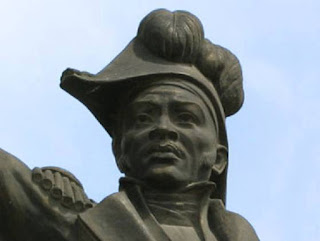

Commentaires